How advances in radiation technology are enabling more precise treatment while protecting healthy tissue
Radiation therapy is built around a fundamental challenge: delivering an effective dose to the tumour while limiting radiation exposure to surrounding healthy tissues.
Modern radiotherapy has made remarkable progress in achieving this balance through advanced imaging, treatment planning and beam-delivery techniques. Yet, for some patients, particularly those with tumours located close to critical organs, even greater control over where radiation is deposited may be clinically valuable.
This is where particle therapy comes into the picture.
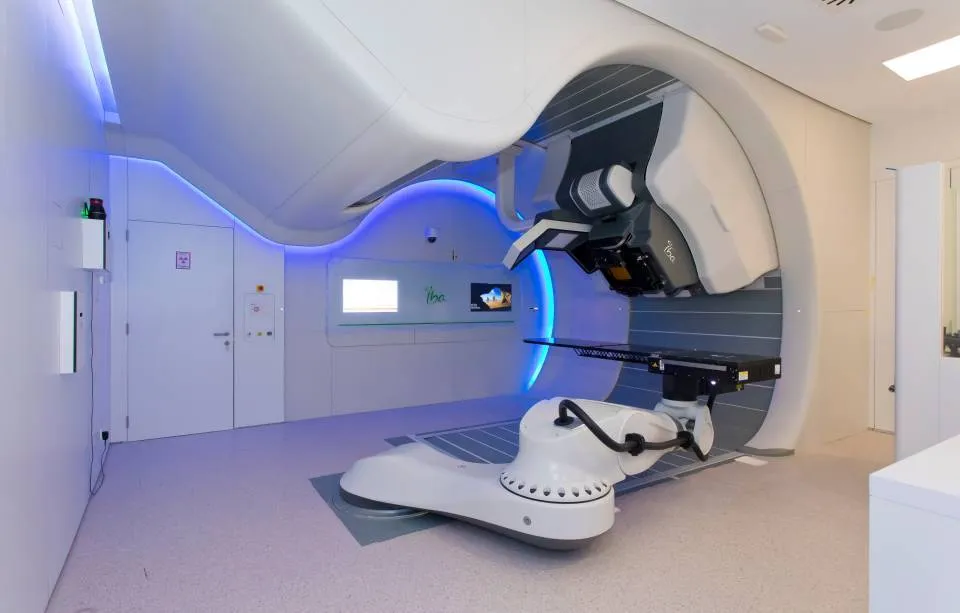
Unlike conventional photon-based radiotherapy, particle therapy uses charged particles such as protons and carbon ions, offering distinctive physical and biological characteristics that can influence how radiation is delivered and how tissues respond.
Importantly, particle therapy is not a replacement for conventional radiotherapy. Its potential value lies in identifying situations where its specific advantages may translate into meaningful clinical benefit.
From photons to particles: what is different?
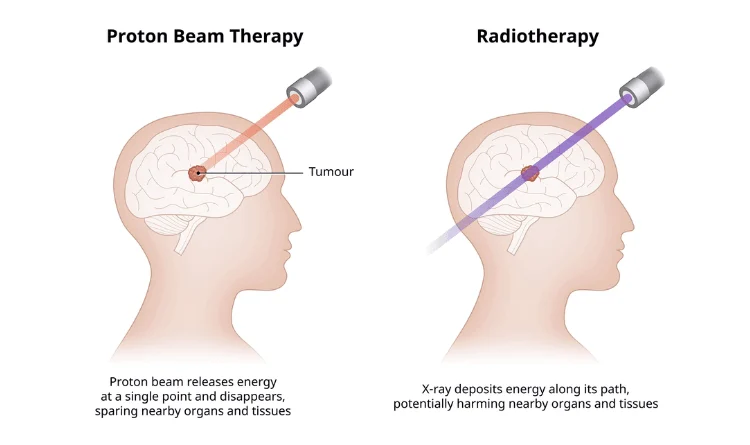
Conventional radiotherapy primarily uses photons (high-energy X-rays). As photons pass through the body, they deposit radiation dose along their path, including beyond the tumour.
Protons behave differently.
As a proton beam travels through tissue, it deposits relatively less energy along the entrance path and releases a large proportion of its dose near the end of its range. This characteristic is known as the Bragg peak.
By adjusting the energy of the proton beam, clinicians can position this peak within the tumour.
The Basic Difference
Photon Therapy
Proton Therapy
This difference can allow proton therapy to reduce unnecessary radiation exposure to tissues beyond the target.
However, the clinical significance depends on the individual treatment plan, tumour location, surrounding organs at risk and the patient’s overall clinical situation.
Why does dose distribution matter?
In radiation oncology, the goal is not simply to deliver radiation to a tumour. It is to achieve an appropriate therapeutic ratio—maximising tumour control while minimising clinically meaningful toxicity.
The ability to reduce dose to normal tissues can become particularly relevant when:
- the tumour is located close to a critical organ;
- a large volume of normal tissue would otherwise receive radiation;
- the patient is young and may face many years of survivorship;
- the patient has previously received radiation to the same or an overlapping region; or
- treatment involves complex anatomy where normal-tissue sparing is particularly challenging.
This is why proton therapy has attracted particular interest in areas such as paediatric oncology, central nervous system tumours, head and neck cancers and selected thoracic and gastrointestinal malignancies.
Where can particle therapy be particularly relevant?
Paediatric cancers
Children may be especially vulnerable to the long-term effects of radiation because of their developing tissues and longer expected survival.
Reducing unnecessary radiation exposure to healthy tissue can therefore be an important consideration when selecting a treatment approach.
For appropriately selected paediatric patients, proton therapy may help reduce radiation dose to organs outside the target while maintaining tumour-directed treatment.
Brain and central nervous system tumours
Tumours in or around the brain and spinal cord present a particular challenge because critical neurological structures may be located close to the treatment target.
The ability to control the distal dose distribution may help reduce unnecessary radiation to surrounding structures in selected cases.
Head and neck cancers
Head and neck radiotherapy often involves several organs at risk, including salivary glands, swallowing structures, spinal cord and other critical tissues.
Reducing unnecessary radiation exposure to these structures may have implications for treatment-related toxicity and quality of life.
Thoracic cancers
For tumours within the chest, reducing radiation exposure to structures such as the heart and healthy lung may be clinically relevant.
Recent comparative evidence in non-small-cell lung cancer suggests that proton therapy may have a role in selected patients at higher risk of treatment-related toxicity, although it has not demonstrated a consistent advantage over photon therapy across unselected patient populations.
Re-irradiation
Patients requiring radiation to a region that has previously been treated present a particularly complex clinical challenge.
Cumulative radiation dose to normal tissues must be considered carefully. In selected re-irradiation scenarios, the ability to reduce dose outside the target may make particle therapy a treatment option worth evaluating.
Is proton therapy always better than photon therapy?
No.
This distinction is important when discussing particle therapy.
Proton therapy has a clear physical advantage in terms of dose distribution in appropriate treatment scenarios. However, a dosimetric advantage does not automatically translate into improved survival or better clinical outcomes.
The evidence is continuing to evolve.
A 2026 umbrella systematic review and meta-analysis comparing proton and photon therapy across multiple malignancies found potential improvements in selected survival and toxicity outcomes with proton therapy. However, among 65 outcomes assessed using GRADE, only two were supported by moderate-certainty evidence, while the majority were supported by low or very low certainty evidence. The authors therefore highlighted the need for larger, high-quality comparative studies.
Similarly, a 2026 GRADE-based assessment of proton therapy in adults concluded that evidence supporting its use varies substantially by tumour type and clinical setting.
The message is therefore not “protons are better than photons.”
The broader particle therapy landscape
Particle therapy extends beyond protons.
Proton therapy
Protons are primarily distinguished by their ability to deposit most of their radiation dose near the end of their range, creating the characteristic Bragg peak.
Their principal clinical interest lies in achieving highly conformal treatment while reducing unnecessary dose to surrounding normal tissues.
Carbon-ion therapy
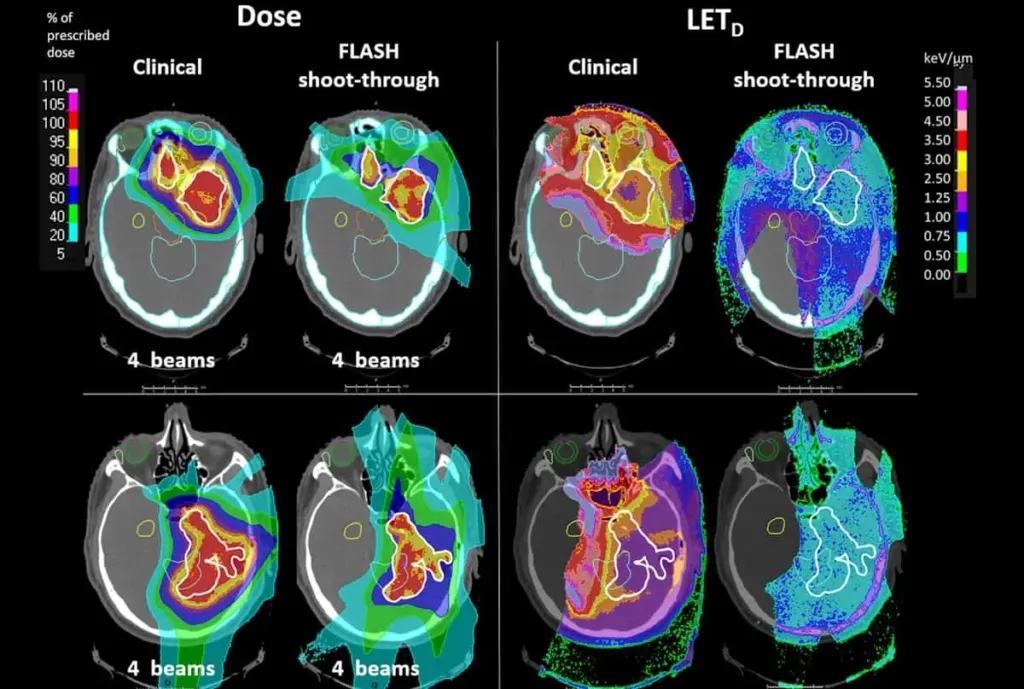
Carbon ions share the characteristic depth-dose advantages of charged particles but also possess a higher linear energy transfer (LET) than protons and photons.
Higher LET radiation can produce greater biological damage per unit of physical dose and may therefore be of interest in selected tumours where radioresistance is an important consideration.
However, the biological effects of heavy-ion therapy are more complex, and treatment planning requires consideration of relative biological effectiveness (RBE) and other radiobiological factors. Current research continues to refine how these biological effects should be modelled clinically.
Helium-ion therapy
Helium ions represent an emerging area within particle therapy.
Their physical and biological characteristics fall broadly between those of protons and heavier ions such as carbon. This has generated interest in whether helium ions could offer a useful balance between dose distribution and biological effects.
However, compared with proton and carbon-ion therapy, the clinical evidence for helium-ion therapy remains much more limited and is still developing.
The particle therapy spectrum
| Modality | Distinguishing Characteristic | Clinical Significance |
|---|---|---|
| Photon | Dose deposited along the beam path with exit dose | Established foundation of modern radiotherapy |
| Proton | Bragg peak with reduced exit dose | Potential normal-tissue sparing in selected patients |
| Carbon Ion | Bragg peak + higher LET | Potential biological advantage in selected settings |
| Helium Ion | Intermediate physical and biological characteristics | Emerging area of investigation |
The evolution of particle therapy therefore goes beyond a simple photon-versus-proton comparison.
It represents a broader effort to understand how different particles can be matched to different clinical and biological challenges.
Precision is only one part of the equation
Particle therapy does not operate in isolation.
The quality of treatment depends on much more than the type of particle used.
Advanced imaging, accurate treatment planning, motion management, image guidance, quality assurance and multidisciplinary expertise are all essential to translating the physical advantages of particle therapy into safe and effective clinical care.
This becomes particularly important because particle therapy introduces its own technical considerations, including range uncertainty and the biological interpretation of RBE and LET.
As the field develops, research is increasingly focused not only on where particles deposit their dose, but also on how that dose produces biological effects within different tissues.
What does this mean for India?
The evolution of particle therapy has particular relevance for a country with a large and growing cancer burden.
For India, expanding access to advanced radiation oncology is not simply a question of installing new technology.
A successful particle-therapy ecosystem requires:
- appropriate patient selection;
- experienced radiation oncologists and medical physicists;
- specialised treatment-planning expertise;
- multidisciplinary clinical decision-making;
- robust quality-assurance systems;
- appropriate infrastructure and trained technical teams; and
- continued generation of clinical evidence and real-world experience.
The challenge is therefore not simply bringing particle therapy to India, but building the clinical ecosystem required to use it appropriately and responsibly.
As more centres and clinicians gain experience with advanced radiation technologies, the role of particle therapy can increasingly be defined by evidence, patient selection and clinical need.
Building the next generation of precision radiation oncology
The future of radiation oncology is not necessarily about choosing one technology over another.
It is about having a broader range of technologies available and understanding when each can provide meaningful value.
For some patients, conventional photon radiotherapy remains the most appropriate and effective treatment.
For others, the ability of protons or heavier ions to alter dose distribution—or, in the case of heavier ions, biological effect—may offer an important therapeutic opportunity.
This patient-specific approach is at the heart of precision radiation oncology.
Against this evolving landscape, access to advanced particle and ion-beam technology becomes an important component of developing future-ready cancer-care infrastructure.
Weembrace and the evolving particle-therapy landscape
In India, Weembrace has been appointed the exclusive importer, commercialisation and distribution partner for TecAustron, a MedAustron Group company specialising in particle therapy and ion-beam systems. The collaboration encompasses technologies involving proton, carbon and helium ions, supported by TecAustron’s expertise in synchrotron-based accelerator technology and established clinical workflows.
The collaboration reflects a broader objective: supporting the development of advanced cancer-care infrastructure and expanding access to precision radiation oncology technologies in India.
As particle therapy continues to evolve, the focus should remain firmly on the intersection of technology, evidence, clinical expertise and patient need.
The future of precision radiation oncology is not about replacing established approaches—it is about having the right technology available for the right patient, at the right time.
Learn more about Weembrace’s particle and ion-beam therapy portfolio and our collaboration with TecAustron on our website.